Some headlines hit hard at first, but don’t quite carry through the same way. You see an initial reaction but it fades quickly. And this has become a common occurrence, especially with regards to Trump’s recent policy-talks.
That’s where “TACO” comes in, and not the food 🌮, but a Wall Street acronym for “Trump Always Chickens Out.” It essentially represents a pattern FT journalist Robert Armstrong noticed over time. And once you see it, it’s hard to ignore.
It usually starts with a big, headline-friendly announcement. Think about the 145% tariffs or buying Greenland. This is followed by market reactions and people panicking, as expected.
Only for Trump to pivot. A delay, a “we’re in talks”, and a slightly softer tone. The situation cools off, panic fades and markets bounce back, almost like they were expecting it.
At this point, even markets seem to know the script.
Some call it a negotiation strategy: start out extreme, then dial it back to meet somewhere in the middle.
Just take a look at the past year, this has played out multiple times:
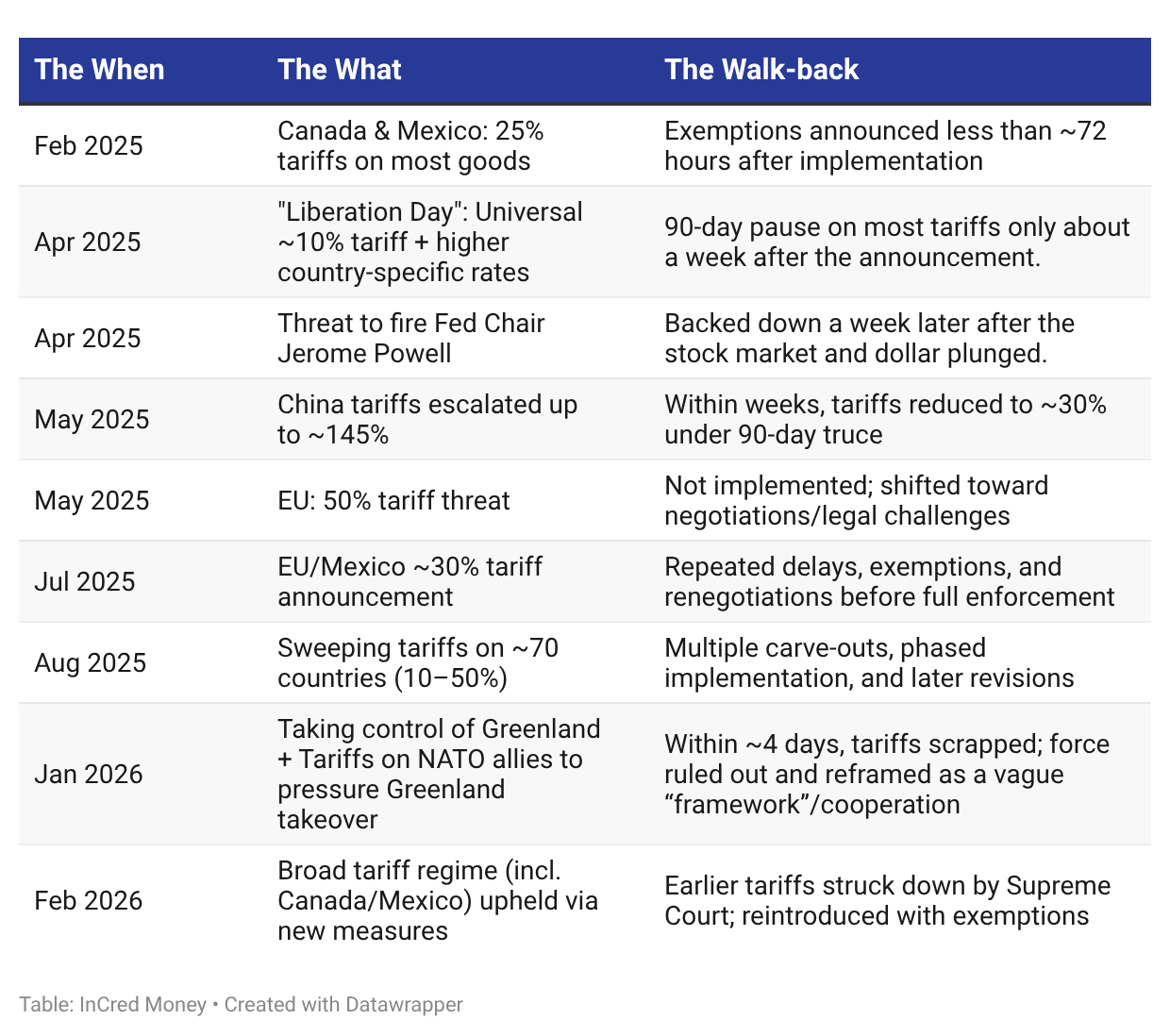
Take China for example. When tariffs as high as 145% were floated by the Trump administration. It looked like a serious escalation but in about a month, things cooled and a truce followed.
Around the same time, the US economy showed its first quarterly GDP contraction since early 2022. On Weibo, “Trump chickened out” started trending and reached up to 150 million views.
Greenland followed a similar pattern: a big announcement, lots of noise, but then not much actually changed.
Wall Street, of course, has adapted. The trade strategy feels pretty straightforward now: buy the dip on the announcement, sell the relief when rollbacks start kicking in.
Which brings us to now.
With the Iran situation building in the background, markets are reacting, but also watching closely for what comes next. Because if this pattern holds, what really matters isn’t the announcement itself, it’s the walk-back.
And quietly, a lot of people are hoping for exactly that, another TACO moment. A softer stance, some backtracking, anything that reduces the risk of escalation.
It’s obviously not the most comforting pattern to rely on. But right now, a game of strategic chicken might be the best-case scenario for everyone.
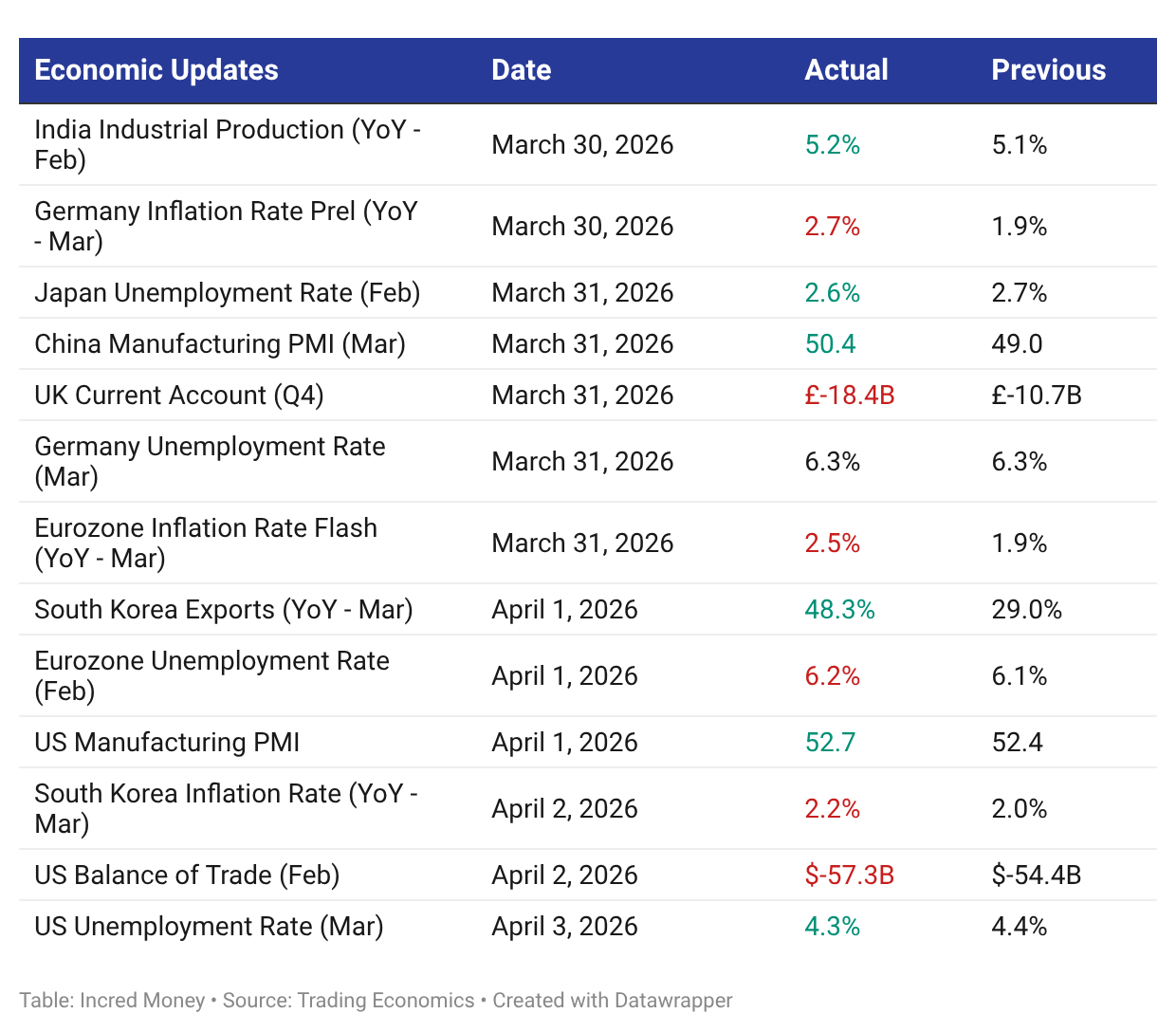
This Week’s Numbers Wrapped Up
India
Industrial activity picks up pace
Industrial production grew 5.2% in February, up from 4.8%, keeping the momentum going.
Strong manufacturing output did the heavy lifting, up 6%, offsetting a slowdown in power generation.
Eurozone
Inflation jumps back above target
Inflation jumped to 2.5% in March, up sharply from 1.9% in February and above the ECB’s comfort zone
The spike was largely driven by energy prices, highlighting how exposed Europe remains to fuel shocks.
China
Factory activity finally rebounds
Manufacturing PMI climbed to 50.4, moving back into expansionary territory after a long slump.
The rebound offers a much-needed boost for an economy dealing with weak demand and global uncertainty.
Germany
Inflation heats up
Inflation rose to 2.7% in March, in line with expectations, picking up from 1.9% in February.
Energy prices were the main culprit, as core inflation remained stable.
South Korea
Exports surge on AI boom
Exports jumped 48.3% YoY, marking the fastest growth in nearly four decades.
The surge to a record high of $86.13 billion was powered by semiconductor demand as the AI boom keeps delivering.
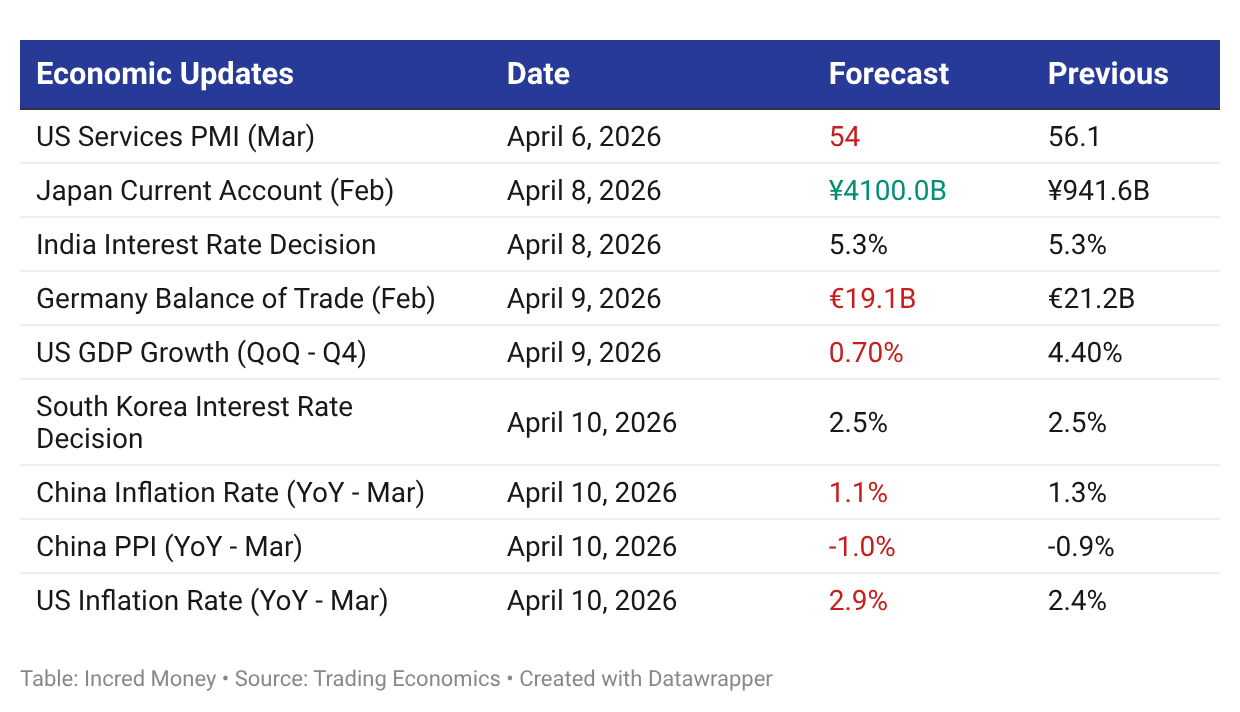
What Can You Expect To See Next Week